Feed is usually the largest single cost on a broiler farm, so feed conversion ratio (FCR) is the number that decides whether a flock makes money. It tells you how many kilograms of feed the birds needed to put on one kilogram of live weight. Lower is better.
How to calculate broiler FCR
The basic formula is:
FCR = total feed used (kg) ÷ total live weight produced (kg)
For a whole flock, "live weight produced" is the weight of birds sold, minus the weight of the chicks you placed.
Example: you place 10,000 chicks at 42 g each (420 kg). At the end of the flock you sell 9,550 birds at an average of 2.4 kg (22,920 kg), and the farm used 36,800 kg of feed.
- Live weight produced: 22,920 − 420 = 22,500 kg
- FCR: 36,800 ÷ 22,500 = 1.64
So the flock needed 1.64 kg of feed for every kilogram of live weight.
Mortality-adjusted FCR
Birds that die still ate feed. Standard FCR spreads that feed over the birds you sold, so a flock with high mortality looks less efficient even if the surviving birds grew well.
Mortality-adjusted FCR adds back the weight of the birds that died:
Adjusted FCR = total feed ÷ (live weight sold + weight of dead birds − chick weight)
In the example, 450 birds died at an average of 1.1 kg (495 kg):
- Adjusted live weight: 22,920 + 495 − 420 = 22,995 kg
- Adjusted FCR: 36,800 ÷ 22,995 = 1.60
Report both numbers. Standard FCR tells you the cost of the flock. Adjusted FCR tells you how well the birds converted feed, separately from how many you lost.
Compare flocks at the same weight
FCR rises as birds get heavier, because a larger bird spends more of its feed on maintenance. A flock sold at 2.8 kg will almost always show a higher FCR than one sold at 2.0 kg. To compare fairly:
- compare flocks taken to a similar age and weight, or
- use your breed company's performance targets for that age and weight as the benchmark.
What pushes FCR up
- Feed wastage: feeder height set wrong, overfilled pans, spills and rodents. Wasted feed is counted as eaten.
- Temperature: cold birds burn feed to keep warm, and heat-stressed birds eat less and grow slower.
- Disease and gut health: even mild coccidiosis or enteritis lowers growth before you see mortality.
- Water: low flow, blocked nipples or poor water quality reduce feed intake and growth.
- Feed quality and form: poor pellet quality and too many fines lower intake.
- Uneven flocks: a wide weight spread usually means some birds are not reaching feed or water.
Track FCR during the flock, not only at the end
An FCR worked out after the birds are sold only tells you what went wrong. Calculating it weekly gives you time to fix it:
- Record feed delivered to each house, and stock left in the bins.
- Weigh a sample of birds each week, from several spots in the house.
- Record mortality and culls every day.
- Work out cumulative FCR to date and compare it with the breed target for that age.
If the weekly FCR drifts above target, check the list above, starting with feeders, temperature and water.
Doing it without spreadsheets
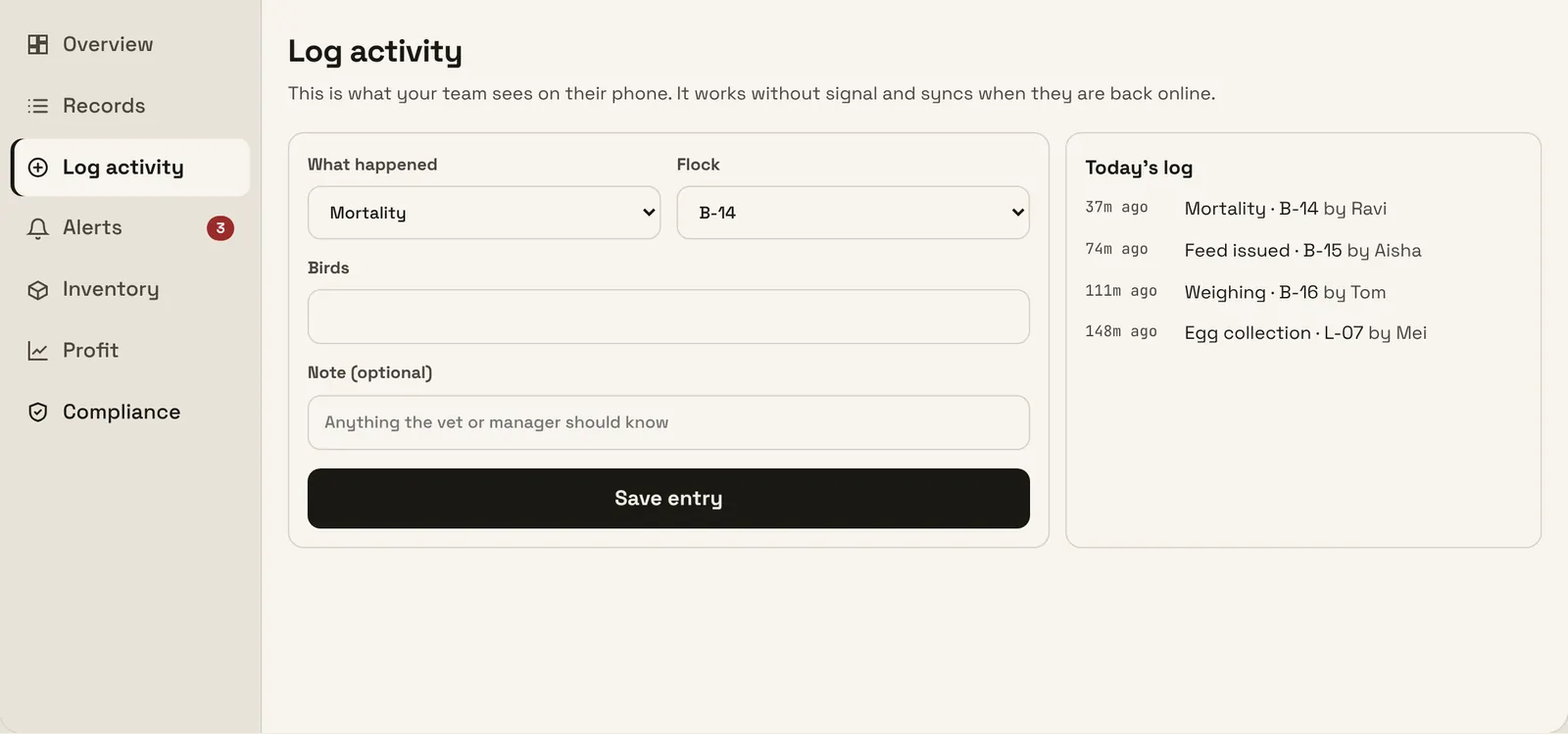
In Decima Farm's poultry farm software, staff log feed, mortality and sample weights from a phone in the shed, even without signal. The dashboard then shows FCR, mortality and weight per flock, and sends a WhatsApp alert when a flock drifts off target. You can try it with your own farm in the live demo.
Frequently asked questions
What is a good FCR for broilers?
It depends on breed, target weight and conditions, so compare against your breed's performance targets at the same age and weight. Heavier birds have a higher FCR, so always compare flocks at a similar slaughter weight.
Should dead birds count in FCR?
Report both. Standard FCR divides all feed by the live weight sold. Mortality-adjusted FCR adds the weight of birds that died, which shows how efficiently the birds converted feed, separate from losses.
How often should I calculate FCR?
Calculate it weekly during the flock using sample weights and feed delivered, then again at the end with actual sold weight. Weekly numbers show problems while you can still act on them.